fliptheswitch.com 1 Critical 2 High 3 Medium 4 Low Audited Jun 10 2026Access used none

Technical audit of fliptheswitch.com

A review run entirely from public data, with no account access. Each finding states the problem, its severity, proof you can reproduce yourself with the relevant Google guideline, and a proposed fix. Every URL below is a live link — click any claim to check it.

Method CrUX field data · Lighthouse · page source · HTTP traces Coverage home + 17 casino pages + 434-page crawl Affiliations none
FAILED
Core Web Vitals on real users (CrUX field data) — LCP & CLS over Google's bar.
~6.2MB
Homepage image payload; one image shipped at three sizes.
237
Affiliate links not disclosed to Google with rel="sponsored".
190
Pages shipping Review schema with an invalid 0/5 rating.
SeverityFindingType
CriticalBroken FanDuel affiliate button — clicks go nowhereRevenue
HighFails Core Web Vitals on real users (field data)Ranking
HighMegabytes of unoptimized homepage imagesPerformance
MediumOptinMonster is ~⅔ of all page requestsPerformance / UX
MediumAffiliate links inconsistently tagged for GoogleSEO integrity
MediumReview schema rates partners "0 / 5" on 190 pagesSEO integrity
Low94 thin archive pages bloat the indexSEO hygiene
LowGeneric homepage title + long post titlesSEO hygiene
LowSlow cold-cache response on long-tail pagesPerformance
LowMissing security/hardening headersHygiene
Findings · ordered by severity
CriticalA monetized FanDuel button links to a broken URLRevenue
Problem
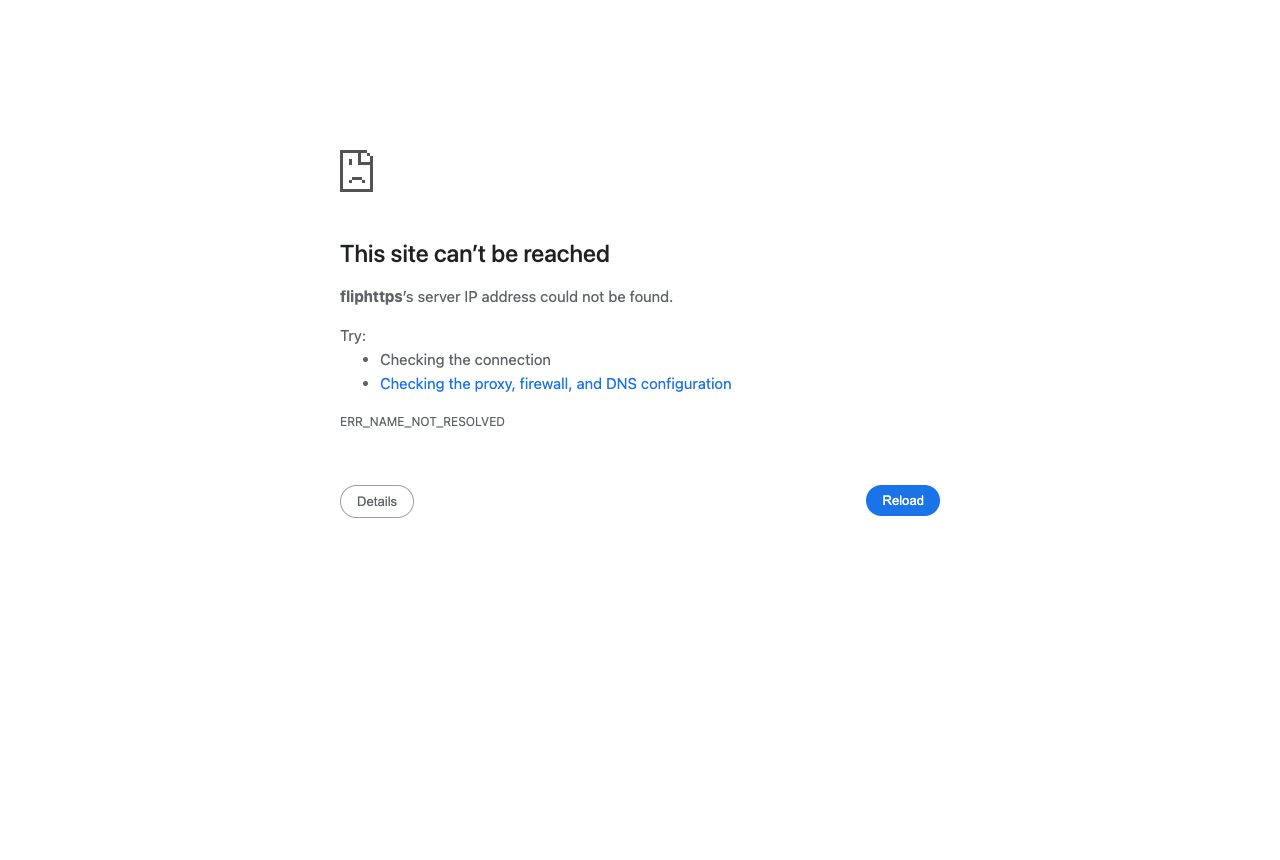
On a published game-review page, the "Play on FanDuel" call-to-action points to a malformed address — the https:// is duplicated (https://fliphttps://). The browser can't resolve it, so the visitor lands nowhere and the affiliate click is lost. This is a dead money link, not an SEO opinion.
Why
On a site that earns almost entirely from affiliate clicks, this is a silent revenue leak: the visitor arrived with intent, clicked to play, and got an error instead of a FanDuel signup — so no commission is earned. Because it looks like a paste/template error, the same break likely sits on other pages, multiplying the loss.
Proof
Page: fliptheswitch.com/game/cleopatra-gold-slot-machine/ Source: <a href="https://fliphttps://fliptheswitch.com/recommends/fanduel-casino/" title="Play on FanDuel" … >Play on FanDuel</a> Result: malformed host → DNS failure, link does not load
FIG 1 — Chrome navigating the live link · captured 2026-06-10
Chrome error: This site can't be reached, fliphttps's server IP address could not be found, ERR_NAME_NOT_RESOLVED
Clicking the button resolves to ERR_NAME_NOT_RESOLVED — the duplicated protocol makes the host fliphttps… invalid. Click the red button below to reproduce it in your own browser.
Fix
Correct the link to …/recommends/fanduel-casino/ (the working version). Then crawl all pages for any href containing fliphttps or a doubled protocol — a paste/template error like this usually repeats.
VERIFY ↳ audited page click the broken link → working version (to see the raw HTML, open the page and prepend view-source:)
HighFails Core Web Vitals on real users (field data)Ranking
Problem
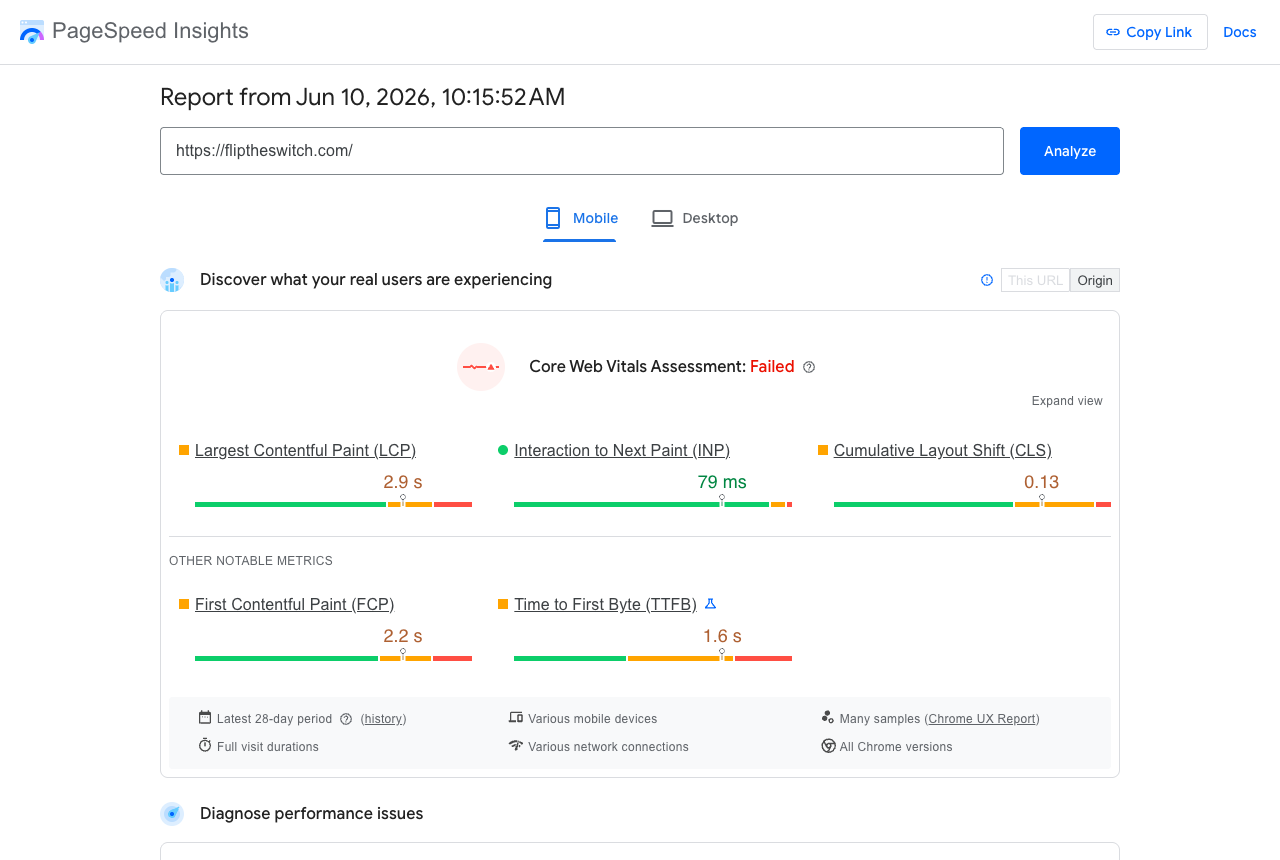
Google's real-user mobile data returns a Failed Core Web Vitals assessment: loading (LCP) and visual stability (CLS) are both over Google's "good" bar. Core Web Vitals is a confirmed ranking signal, and the business depends on organic search, so this is an ongoing drag on visibility. (LCP 2.9s is moderately over — not "broken" — but the overall assessment fails because two metrics are over.)
Why
Core Web Vitals is a confirmed Google ranking factor, and this site grows almost entirely through organic search — so a failing real-user score is a standing handicap on every term it competes for, while faster competitors get the tie-breaker. Slower mobile loading also means more visitors leave before the page (and its affiliate links) finish appearing.
Proof
Source: Google CrUX field data (real visitors, 28-day, mobile) LCP 2.9 s — Google "good" ≤ 2.5 s → over CLS 0.13 — Google "good" ≤ 0.10 → over INP 0.079 s — passes FCP 2.2 s TTFB 1.6 s Overall assessment: FAILED
FIG 2 — pagespeed.web.dev · mobile · 2026-06-10
Google PageSpeed Insights: Core Web Vitals Assessment Failed, LCP 2.9s, CLS 0.13, from CrUX field data
Google PageSpeed Insights, real-user field panel: Core Web Vitals Assessment: Failed, from the Chrome UX Report (28-day window — re-run any time to confirm current state).
Fix
Addressed by finding 3 — image weight is the dominant lever on mobile LCP.
HighMegabytes of unoptimized homepage imagesPerformance
Problem
Photographic slot artwork is served as large PNGs, and one image is loaded at three different resolutions on a single page. PNG is the wrong format for photos, and shipping multiple sizes multiplies the weight. This is the main reason mobile LCP is slow — and it's measurable and repeatable, not a flaky test.
Why
This is the root cause of the ranking problem in finding 2, and the highest-leverage fix on the list. Mobile is the large majority of casino traffic; a multi-megabyte homepage on a phone shows a visible delay before anything paints, and every extra second loses visitors before they reach a single affiliate link.
Proof
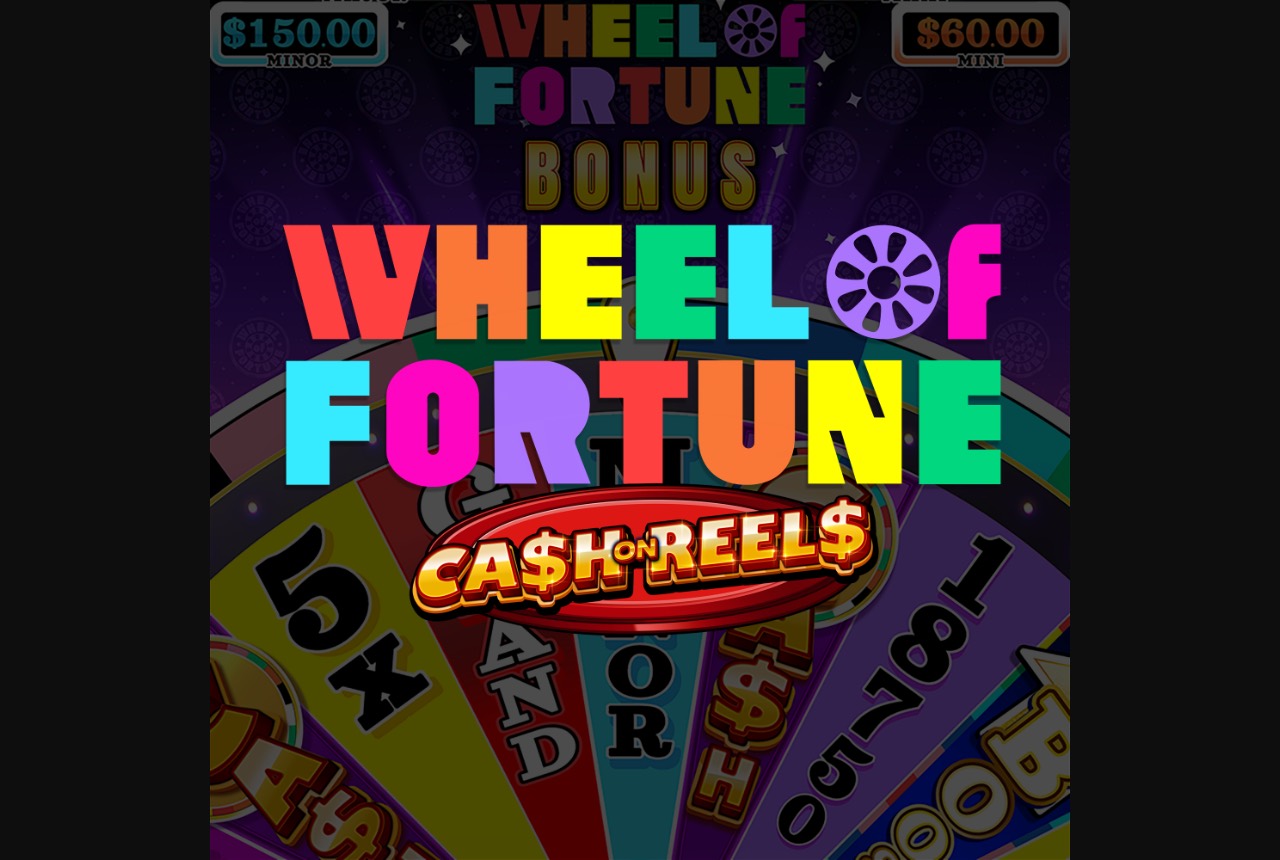
Live image weights (HTTP Content-Length, homepage): 1,916 KB wheel-of-fortune-cash-on-reels.png ┐ same 1,521 KB …-1536x1536.png │ image, 814 KB …-1024x1024.png ┘ 3 sizes ≈ 4.2 MB 846 KB Untitled-design-767x767.png (Canva export) ≈ 6.2 MB total initial image payload (the four files above are ~5.1 MB of it)
FIG 3 — the 1.9 MB file opened directly · click to load it yourself
The wheel-of-fortune slot image opened directly — photographic artwork served as a 1.9MB PNG
The single worst offender: 1.9 MB of photographic slot art saved as .png (same image also loaded at 1.5 MB and 0.8 MB). Photographic content belongs in WebP/AVIF at one size.
Fix
Convert photographic PNGs (Canva exports, pasted screenshots) to WebP/AVIF and serve one correctly-sized variant per slot. Roughly 3–4 MB saved on the homepage alone. Theme thumbnails are already WebP — only hand-added images need attention.
VERIFY ↳ open the 1.9 MB image run PageSpeed § web.dev: modern formats (DevTools → Network → Img, or curl -I each URL)
MediumOptinMonster is roughly two-thirds of all page requestsPerformance / UX
Problem
The email-popup tool accounts for the majority of network requests on the homepage and is the largest third-party consumer of main-thread time. Its popup also fires on the reading path, interrupting visitors before they reach an affiliate link.
Why
Two costs. Performance: at two-thirds of all requests and the largest main-thread blocker, it's a major contributor to the slow load in findings 2–3. Conversion: the popup interrupts the reader mid-page, before the affiliate CTA — trading a possible email signup for the higher-value affiliate click this site actually runs on.
Proof
Network capture (homepage): api.omappapi.com ×147 + a.omappapi.com ×18 = 165 / 250 requests (66%) Main-thread blocking: OptinMonster ~209 ms (largest third-party) (Re-counted live 2026-06-10: 100+ omappapi requests in a single load.)
Fix
Defer/lazy-load OptinMonster until after first paint, reduce its request volume, and hold the popup until the reader engages (exit-intent) rather than firing on the way in.
VERIFY ↳ homepage § web.dev: third-party JS (DevTools → Network → filter omappapi.com, reload, count)
MediumAffiliate links are inconsistently tagged for GoogleSEO integrity
Problem
Google asks that affiliate/monetized links be marked rel="sponsored" (or nofollow). The link component is inconsistent: the same affiliate destination is marked nofollow in one button style but left undisclosed (noopener noreferrer only) in another — on the same page. Across the site this leaves hundreds of paid links undeclared.
Why
Undisclosed paid links are a Google link-scheme signal: at best the link equity passing through them is discounted, at worst hundreds of undeclared links to gambling partners is the kind of pattern that draws a manual action. Either way the site loses control over how its own authority is spent and carries avoidable, domain-wide policy risk.
Proof
Same URL, same page (/casino/betmgm-casino/), two renders: <a href="…/recommends/betmgm-casino/" rel="nofollow">Play Now</a> <a href="…/recommends/betmgm-casino/" rel="noopener noreferrer"> (undisclosed) Site-wide crawl (434 pages, 3,500 /recommends/ links): 237 affiliate links missing both nofollow and sponsored
Fix
Have the affiliate-link component always output rel="sponsored nofollow noopener noreferrer", including the cloaked /recommends/ links, then re-crawl to confirm. A single shared component covers the large majority of the 237; check for any links emitted by other templates/plugins too.
VERIFY ↳ the page (compare the two buttons) § Google: qualify outbound links (View-Source, search recommends/betmgm)
MediumReview schema rates every partner "0 / 5", across 190 pagesSEO integrity
Problem
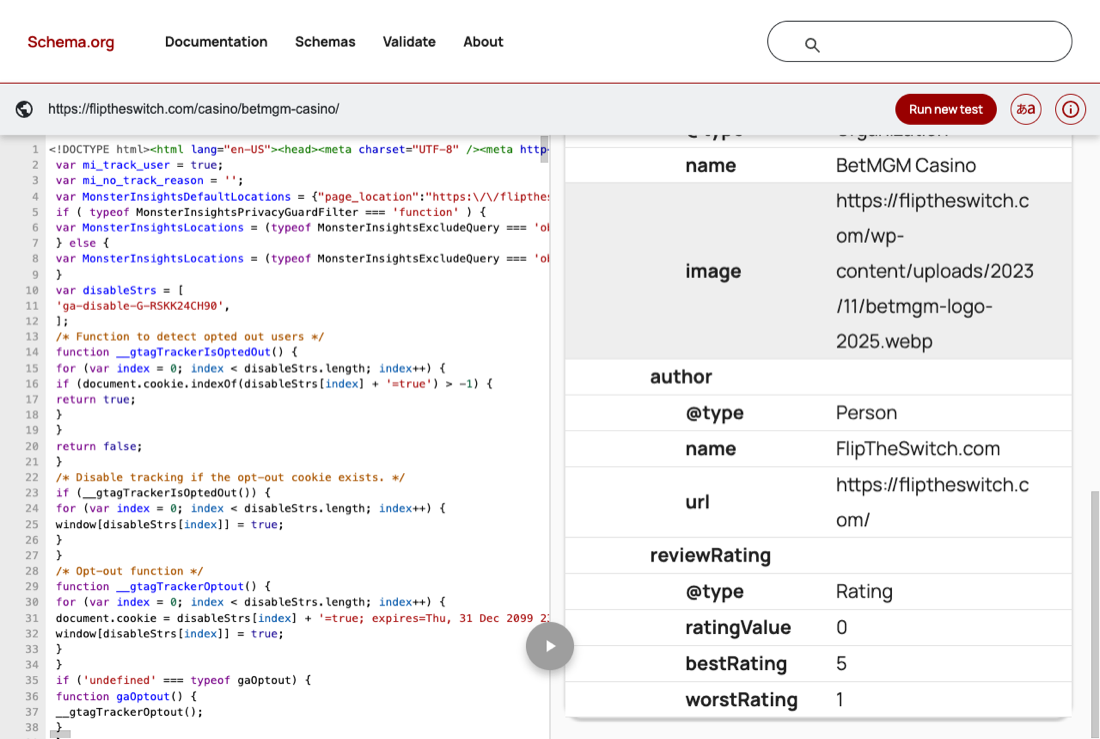
190 pages ship Review structured data with ratingValue:"0", authored by the site itself about an affiliate partner. A 0 rating is invalid for a star snippet, and Google does not show self-serving review snippets — so the markup earns no rich result and presents invalid, self-referential review data at scale.
Why
The markup was meant to earn star ratings in search results, which lift click-through. Instead it earns nothing — a 0 rating is invalid and self-authored reviews are ineligible — while publishing invalid, self-serving structured data on 190 pages, which reads as manipulative markup rather than a ranking asset.
Proof
JSON-LD found on casino, game, and article pages alike: "@type":"Review", "author":{"@type":"Person","name":"FlipTheSwitch.com"}, ← self "reviewRating":{"ratingValue":"0","bestRating":"5"} ← invalid Crawl: 190 pages with Review schema, all ratingValue 0
FIG 4 — schema.org validator parsing the live BetMGM page
Schema.org validator showing a Review authored by FlipTheSwitch.com with a reviewRating block
The official Schema.org validator on the live BetMGM page: a Review whose author is "FlipTheSwitch.com" (the site reviewing its own affiliate partner), carrying a reviewRating of 0. Repeated on 190 pages.
Fix
Remove the Review/Rating schema unless a page has a genuine editorial rating that meets Google's rules. Keep Article, BreadcrumbList, and FAQ where they legitimately apply.
Low94 thin archive pages are indexable and in the sitemapSEO hygiene
Problem
Yoast exposes 94 low-intent archive URLs (vendor / tag / author) as index,follow, most with no meta description. These thin pages dilute crawl focus and can compete with the real review/category pages you want ranking.
Why
Google gives each site a limited crawl and attention budget. 94 thin, description-less pages absorb some of it and compete with the real review and category pages for the same terms, muddying which page Google chooses to rank. Pruning them concentrates authority on the pages that actually convert.
Proof
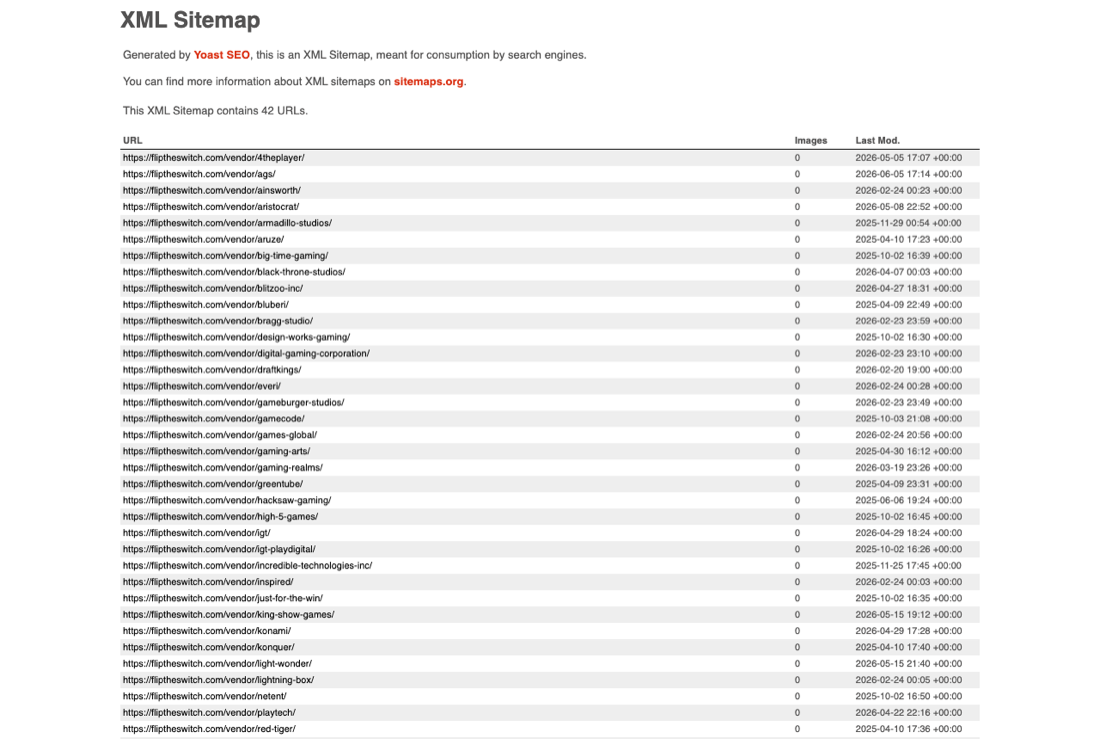
Archive URLs in XML sitemaps: vendor 42 (39 missing meta description) · tag 24 (23 missing) author 9 · category 13 · game-category 3 · casino-category 3 = 94 e.g. /vendor/4theplayer/ → "4ThePlayer Archives - Flip The Switch", no description
FIG 5 — the live Yoast vendor sitemap
The live Yoast vendor sitemap listing dozens of thin vendor archive URLs as indexable
The live vendor-sitemap.xml — dozens of thin /vendor/ archive pages submitted to Google as indexable. 94 such URLs across all archive sitemaps.
Fix
Set thin tag/vendor/author archives to noindex and drop them from the XML sitemap; keep only category hubs that have unique copy and search demand.
LowGeneric homepage title; many post titles run longSEO hygiene
Problem
The homepage <title> is "Home - Flip The Switch" — the highest-value SEO tag spent on the word "Home". Separately, about 60% of post titles run past ~62 characters, so Google often truncates or rewrites them in results.
Why
The title tag is the single biggest lever on whether a searcher clicks your result. Spending the homepage's title on the word "Home" wastes the most valuable tag on the site, and titles cut off mid-sentence lower click-through on rankings you've already earned — free traffic left on the table.
Proof
Homepage: <title>Home - Flip The Switch</title> Long titles are clipped/rewritten once the " - Flip The Switch" suffix is added.
Fix
Give the homepage a keyword-rich title (brand + primary topic). Trim post titles to roughly 60 characters before the brand suffix.
LowSlow response on cold (uncached) page loadsPerformance
Problem
A warmed page responds in ~0.06s, but the first (uncached) request takes ~0.8s to start sending — so pages that get sporadic organic traffic feel slow on the visit that matters. A fair nuance to the "caching helps" point: caching does help repeat hits, but cold long-tail pages don't get that benefit, and it doesn't change findings 2–3.
Why
Long-tail pages — the bulk of an SEO site — get sporadic traffic, so they're frequently served cold: the visitor arriving from search waits ~0.8s before anything starts, on top of the image delay in finding 3. Smaller than #3, but it compounds it on exactly the pages that depend on organic discovery.
Proof
Time-to-first-byte, repeated requests: home / casino / game / vendor pages: cold ≈ 0.80 s, warm ≈ 0.06 s Command: curl -s -o /dev/null -w "%{time_starttransfer}\n" <url> (run twice)
Fix
Prewarm the cache for key templates (home, casino, game, top categories) after each deploy or content update.
VERIFY ↳ homepage (run the curl command above twice — the first hit is markedly slower)
LowMissing security/hardening headersHygiene
Problem
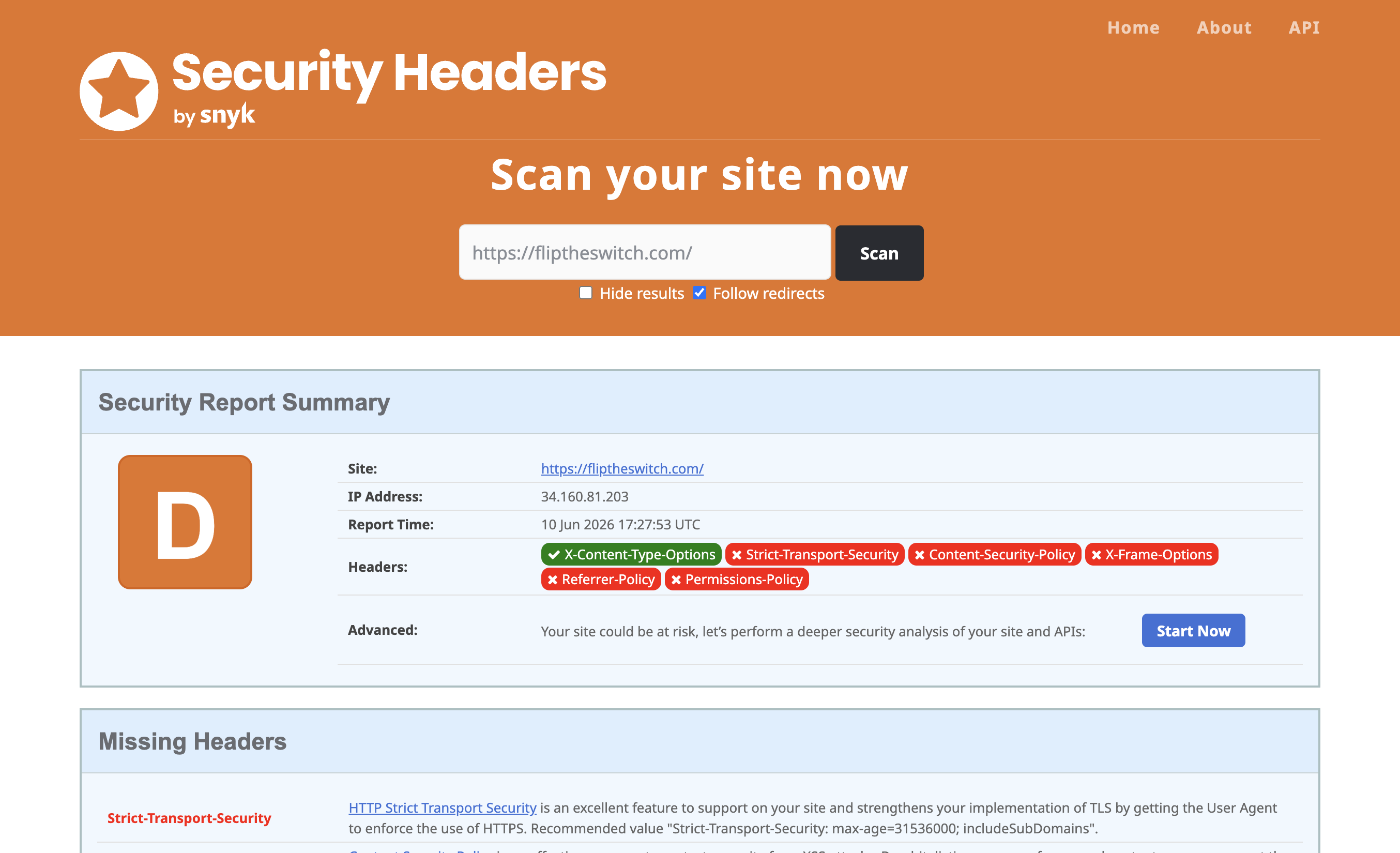
The site sends none of the common hardening headers (HSTS, CSP, X-Frame-Options, Referrer-Policy, Permissions-Policy) — only X-Content-Type-Options. Not a revenue or ranking issue, but cheap defensive hygiene; an independent scanner grades it a "D".
Why
Low urgency, but missing headers like HSTS and X-Frame-Options leave the site marginally more exposed to protocol-downgrade and clickjacking, and a public "D" grade is an easy criticism if a partner or advertiser checks. Cheap to fix; it removes a needless vulnerability and a bad look.
Proof
Response headers present: x-content-type-options: nosniff Absent: strict-transport-security, content-security-policy, x-frame-options, …
FIG 6 — securityheaders.com (by Snyk) · 2026-06-10
securityheaders.com grading fliptheswitch.com a D, with missing HSTS, CSP, X-Frame-Options
Independent grade: D. Only X-Content-Type-Options is present (green); HSTS, CSP, X-Frame-Options, Referrer-Policy and Permissions-Policy are all missing (red).
Fix
Add HSTS, a baseline CSP, and X-Frame-Options at the server or CDN edge.
VERIFY ↳ re-scan on securityheaders.com § OWASP Secure Headers (or curl -I https://fliptheswitch.com/)
Context

Is this just how casino sites load?

Partly — and it's worth being precise rather than overstating it. By Google's real-user field data, Core Web Vitals is genuinely hard across this niche: three of these four sites fail it. But casino.org passes, which shows the bar is achievable, not a law of the niche. The honest goal isn't "beat everyone" — it's to fix the ~6 MB of images (finding 3) and join casino.org on the passing side.

SiteCore Web Vitals — real users (CrUX, mobile)Check
fliptheswitch.comFailed LCP 2.9s & CLS 0.13 over the barrun ↗
casino.orgPassed a peer that meets Google's barrun ↗
vegasslotsonline.comFailedrun ↗
gambling.comFailed fast LCP (1.5s) but fails overallrun ↗

Google CrUX field data (real users), checked 2026-06-10 — click "run" to reproduce any row. A separate Slow-4G lab stress test puts Flip The Switch as the heaviest page of the group, which is consistent with finding 3 (it carries the most removable weight). Lab figures vary run-to-run, so they're context, not a scoreboard — the field column above is the measure Google ranks on.

Checked & clean

What's working well

An honest audit names what's right. These were checked and are in good shape:

  • Real, substantial content — game pages average ~1,556 words
  • Unique titles & meta descriptions, no keyword cannibalization
  • Fully indexable; robots.txt valid; clean redirects
  • No broken posts found in sampling; internal links clean
  • Cloaked affiliate links resolve and carry tracking IDs (credit intact)
  • HTTP/2, gzip, proper 404s, zero mixed content
  • Single H1, proper heading structure, image alt text present
  • Zero paid ad spend at risk — confirmed via Google Ads Transparency
Recommended order of work
WhenDoWhy
This weekFix the broken FanDuel link (#1) + crawl for other malformed linksRecovers lost clicks; minutes of work
This weekPatch the affiliate-link component to emit rel="sponsored…" (#5)Clears the large majority of 237
This sprintCompress/convert homepage + casino images (#3)Moves the real-user CWV (#2)
This sprintRemove/repair the 0-rating Review schema (#6)Stops invalid data on 190 pages
BacklogDefer OptinMonster (#4); noindex thin archives (#7); titles (#8); cache prewarm (#9); headers (#10)Incremental gains